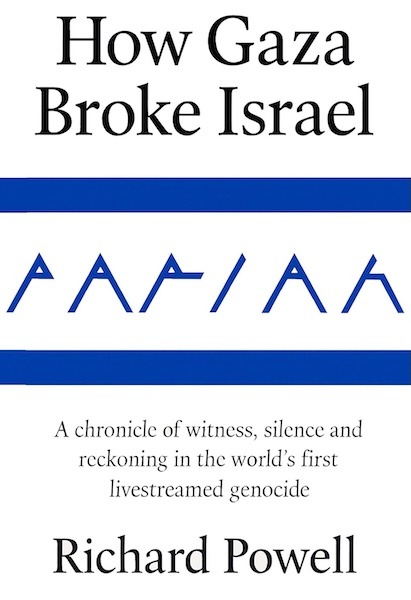
In the aftermath of most wars, the question is who won. Richard Powell’s Pariah: How Gaza Broke Israel asks a more destabilising question: what does victory mean in an era where legitimacy may matter as much as territory?
Powell’s book enters the crowded field of writing on the Israel–Palestine conflict with a sharply defined thesis. The Gaza war, he argues, marked a rupture not only in regional security dynamics but in Israel’s standing within the international system. Military superiority remained intact. Deterrence capacity remained formidable. Yet something less tangible, and perhaps more consequential, was weakened: diplomatic credibility.
The book refuses to begin on 7 October 2023. Instead, Powell traces the structural foundations of Gaza’s fragility. He revisits the blockade, the regulation of goods and movement, the demographic anxieties embedded in strategic planning, and the administrative logic that treated the territory as a controlled space rather than a sovereign one. By reconstructing this architecture of containment, Powell frames the humanitarian collapse not as spontaneous tragedy but as the visible consequence of long-term policy.
This historical framing is not ornamental. It is central to the book’s argument about legitimacy. If devastation arises within a sustained system of restriction, then reputational exposure cannot be dismissed as the by-product of emergency action.
Powell’s geopolitical analysis unfolds across multiple layers. He examines voting patterns at the United Nations, diplomatic language used by Western governments, and statements from countries across Africa, Latin America and Asia. In his reading, Gaza became a global litmus test for the consistency of international norms. When some governments invoked international humanitarian law cautiously while others spoke more forcefully of accountability, divergence became visible.
The International Court of Justice and the International Criminal Court occupy a significant portion of the narrative. Powell details provisional measures, jurisdictional debates and the political ramifications of formal legal proceedings. His argument is not that judicial bodies alone determine geopolitical outcomes, but that the institutionalisation of allegations alters diplomatic calculation. Once the vocabulary of genocide, proportionality and collective punishment enters formal proceedings, it cannot easily be confined to rhetoric.
The United States features prominently in Powell’s assessment. Congressional votes, executive messaging and vetoes at the United Nations Security Council are examined as indicators of alliance strain. Powell suggests that generational divisions within American politics, particularly among younger voters, intensified during the Gaza war. While formal alignment between Washington and Jerusalem remained intact, public opinion fractured in more visible ways.
The book also addresses Europe’s internal tensions. Parliamentary rebellions, public demonstrations and debates within major political parties are presented as signs that Gaza unsettled established diplomatic reflexes. Powell does not predict rupture. He predicts recalibration.
Energy politics and regional infrastructure add another dimension. Eastern Mediterranean gas reserves, maritime corridors and commercial agreements are woven into the broader geopolitical canvas. While these factors are not presented as sole motives, Powell argues they complicate any purely moral interpretation of strategic decision-making.
The tone throughout is morally direct. Powell does not attempt to present Israel and Palestine as symmetrical actors in the conflict. Israeli security concerns are acknowledged but do not anchor the narrative. Critics may argue that counter-arguments receive limited expansion. Yet the consistency of the framework is difficult to ignore.
One of the book’s most debated sections concerns casualty estimation and indirect mortality. Powell challenges narrow counting practices that exclude deaths resulting from siege conditions, infrastructure collapse and lack of medical access. Whether readers agree with his methodology or not, the argument underscores his broader claim: how casualties are counted shapes how history records responsibility.
As a work of contemporary political analysis, Pariah is not written from archival distance. It intervenes while the record remains active. That urgency gives the book both its force and its edge.
For readers seeking a sustained examination of how Gaza affected Israel’s diplomatic standing, legal exposure and alliance politics, Powell offers a structured and comprehensive argument. Agreement is not required to recognise that legitimacy has become a central strategic variable in modern conflict.
In Gaza, Powell contends, military dominance did not guarantee reputational stability. Whether that recalibration proves temporary or enduring remains to be seen.
Pariah: How Gaza Broke Israel is available in ebook, paperback and hardback through major retailers, including Amazon. Full purchase details are provided at https://pariahbook.com/, where readers can also download the first three chapters free of charge.